

 français
 English
 Deutsch
 español
 العربية
 中文
中文
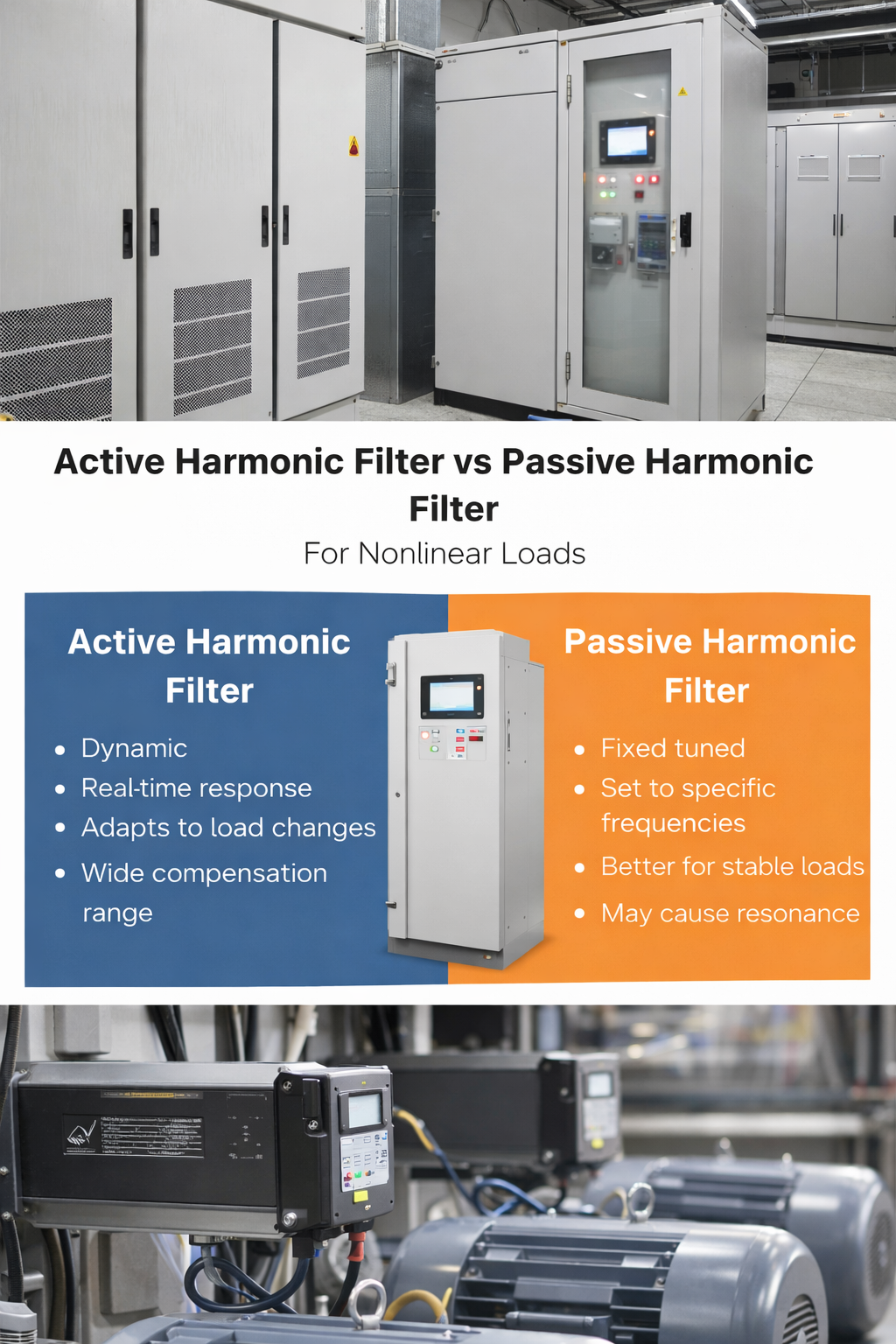
Filtre harmonique actif vs filtre harmonique passif
Les installations modernes dépendent d'équipements qui améliorent l'efficacité et le contrôle, mais ces mêmes équipements sont souvent à l'origine de graves problèmes de qualité de l'énergie. Dans un réseau électrique industriel, les charges non linéaires telles que les variateurs de fréquence, les redresseurs, les systèmes d'alimentation sans coupure (UPS), les postes à souder et les alimentations à découpage peuvent générer de la distorsion harmonique. Lorsque cette distorsion harmonique augmente, le système peut subir une surchauffe, des déclenchements intempestifs, une baisse des performances des transformateurs et une réduction de la durée de vie des équipements.
C’est pourquoi l’atténuation des harmoniques est devenue un élément majeur de la conception de la qualité de l’énergie. Deux solutions courantes sont le filtre actif d’harmoniques et le… filtre harmonique passif Ces deux systèmes visent à réduire la distorsion harmonique, mais leur fonctionnement est très différent. Le choix du système le plus adapté dépend du type de charge, de la stabilité du système et du niveau de flexibilité requis.
Dans un système normal, le courant devrait suivre la fréquence fondamentale de l'alimentation. Les charges linéaires conservent généralement un comportement proche de cette fréquence et génèrent peu de distorsion. Ce n'est pas le cas des charges non linéaires. Elles consomment du courant par impulsions, ce qui crée des fréquences supplémentaires supérieures à la fréquence fondamentale. C'est pourquoi la réduction des harmoniques est essentielle dans un réseau électrique industriel moderne.
Dans un réseau électrique sain, le courant suit une onde sinusoïdale régulière. Distorsion harmonique Ce phénomène se produit lorsque des charges non linéaires consomment du courant par impulsions plutôt que sous forme d'onde continue. Ces fréquences supplémentaires circulent dans le réseau électrique industriel et génèrent chaleur, pertes et contraintes.
Un variateur de fréquence est l'une des sources les plus courantes de distorsion harmonique. Il améliore la commande du moteur et permet des économies d'énergie, mais il modifie également la forme d'onde du courant qu'il consomme. Lorsqu'un site comporte de nombreux variateurs fonctionnant sur le même bus, la distorsion harmonique totale peut augmenter rapidement.
C’est pourquoi de nombreuses usines, bâtiments commerciaux, stations d’épuration et centres de données ont besoin d’une solution dédiée à la qualité de l’énergie électrique au lieu de se fier uniquement à des équipements de compensation standard.
Un filtre harmonique passif utilise des condensateurs, des inductances et des éléments résistifs pour cibler des fréquences harmoniques spécifiques. Il est conçu en fonction des conditions connues du système et généralement réglé pour réduire certains ordres harmoniques.
Un filtre harmonique passif est performant lorsque le profil de charge est stable et le spectre harmonique prévisible. On le rencontre fréquemment dans les systèmes dont les conditions de fonctionnement varient peu au cours de la journée.
Le principal avantage d'un filtre harmonique passif réside dans sa simplicité. Il peut se révéler efficace pour un problème spécifique si l'application est bien comprise. Cependant, il est moins flexible lorsque le système évolue ou que les conditions harmoniques varient dans le temps.
Un filtre harmonique actif Il s'agit d'un dispositif dynamique de qualité de l'énergie qui détecte les courants harmoniques et injecte des courants de compensation en temps réel. Au lieu de cibler une seule fréquence, il réagit en permanence à la forme d'onde réelle présente sur le réseau.
Cela rend le filtre harmonique actif plus adaptable qu'un filtre harmonique passif. Il est particulièrement performant dans les systèmes à charges variables, comportant plusieurs variateurs de fréquence ou des sources mixtes de distorsion harmonique.
Du fait de sa réponse en temps réel, un filtre harmonique actif est souvent utilisé dans les applications modernes des systèmes d'alimentation industriels où la flexibilité, la stabilité et une compensation précise importent plus qu'une approche à réglage fixe.
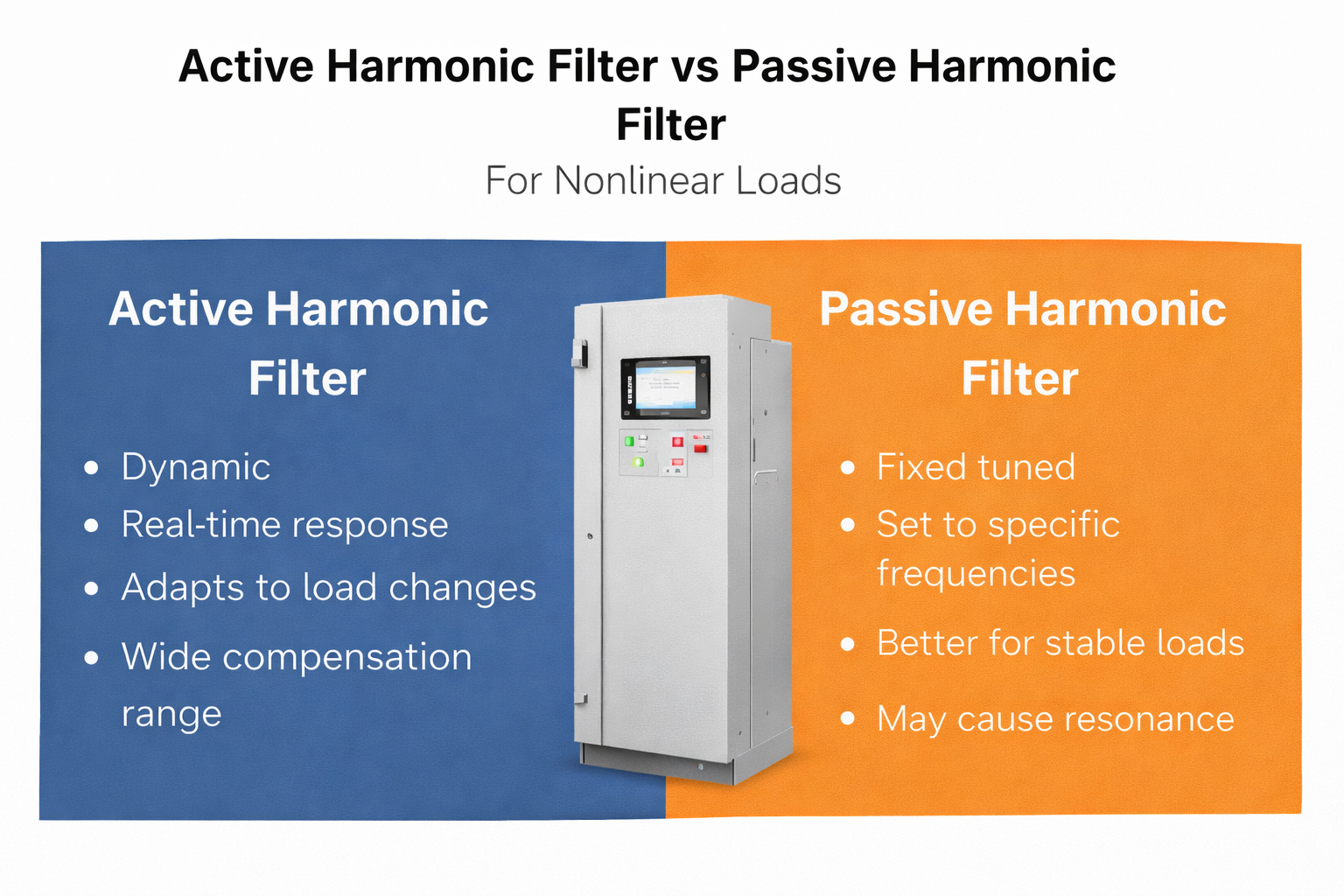
La principale différence réside dans la manière dont chaque solution gère la distorsion harmonique.
Un filtre harmonique passif est fixe. Il est conçu pour certains ordres harmoniques et fonctionne de manière optimale lorsque le système reste proche de ses conditions de conception initiales.
Un filtre harmonique actif est dynamique. Il surveille la forme d'onde et réagit aux variations des conditions harmoniques au fur et à mesure qu'elles se produisent.
Concrètement, cela signifie :
Pour les sites soumis à de fréquentes variations de charge, une solution fixe peut s'avérer insuffisante. C'est là que le filtre harmonique actif devient souvent la solution la plus performante sur le long terme.
Les charges non linéaires complexifient le contrôle des harmoniques car leur comportement est instable. Un site peut présenter des conditions de fonctionnement différentes selon les moments : matin, après-midi et pic de production. L’augmentation du nombre de variateurs de fréquence et de dispositifs d’électronique de puissance entraîne également une modification de la distorsion harmonique.
C’est précisément dans ce type d’environnement qu’un filtre harmonique actif donne d’excellents résultats. Il s’adapte aux conditions réelles du réseau au lieu de se baser sur un point de réglage fixe.
Un filtre harmonique passif peut encore s'avérer utile, mais il est généralement plus efficace lorsque le profil harmonique reste relativement constant. Si le système est sujet à des variations, ses performances risquent de ne plus correspondre aux conditions réelles de fonctionnement.
Les variateurs de fréquence sont désormais courants dans les pompes, les ventilateurs, les compresseurs, les convoyeurs et les équipements de production. En faible quantité, l'effet harmonique reste gérable. En revanche, en grande quantité, l'impact sur la qualité de l'énergie électrique devient beaucoup plus préoccupant.
Pour les applications comportant plusieurs variateurs de fréquence, le filtre harmonique actif est souvent préférable car il réagit en temps réel aux variations de charge. Il réduit la distorsion harmonique sans être limité à une plage de fréquences de réglage étroite.
Cela offre aux opérateurs un système d'alimentation électrique industriel plus stable et réduit le risque de surchauffe des câbles, de déclenchement des disjoncteurs, de surcharge des transformateurs ou d'endommagement d'autres équipements connectés.
Un filtre harmonique actif offre plusieurs avantages dans les applications modernes de qualité de l'énergie :
Ces avantages rendent le filtre harmonique actif intéressant pour les sites qui ont besoin d'une solution de qualité de l'énergie plus large et plus adaptative.
Un filtre harmonique passif n'est pas obsolète. Il a encore sa place dans certains projets.
Cela peut avoir du sens lorsque :
Dans un système adapté, un filtre harmonique passif peut encore offrir des performances acceptables. Le problème est que de nombreux sites modernes ne sont plus suffisamment simples ou stables pour une approche exclusivement fixe.
Avant de choisir un filtre harmonique actif ou passif, il convient de mesurer correctement le système. Les facteurs importants sont les suivants :
Ceci est important car la solution de qualité d'énergie appropriée dépend de l'état réel du système électrique du site, et non pas seulement d'une liste d'équipements de base.
La meilleure approche à long terme ne consiste pas seulement à réduire une valeur mesurée pendant une seule journée. Il s'agit d'améliorer la stabilité de l'ensemble du réseau électrique industriel.
Si un site présente des charges non linéaires variables, une automatisation croissante ou de nombreuses applications de variateurs de fréquence, une solution flexible offre généralement de meilleurs résultats à long terme. Dans ces conditions, un filtre harmonique actif assure souvent une protection renforcée et un contrôle des harmoniques plus fiable qu'un filtre harmonique passif seul.
L'objectif n'est pas seulement de réduire la distorsion harmonique. Il s'agit aussi de diminuer les déplacements, de réduire la chaleur, d'allonger la durée de vie des équipements et d'obtenir une production plus stable.
La réduction des harmoniques ne se limite pas à l'amélioration d'une seule mesure dans un rapport. Elle contribue à protéger les transformateurs, les câbles, les appareillages de commutation et les équipements connectés contre la surchauffe et les contraintes excessives. Dans les installations comportant de nombreuses charges non linéaires, le contrôle des harmoniques favorise une meilleure stabilité de l'ensemble du réseau électrique industriel.
Ceci est particulièrement important lorsque des charges linéaires et non linéaires fonctionnent simultanément sur le même bus. Même si certaines parties du réseau restent stables, la distorsion croissante due aux charges électroniques peut affecter l'ensemble du système. C'est pourquoi une stratégie de filtrage efficace améliore la qualité de l'énergie et la durée de vie des équipements sur le long terme.
Conclusion
Les filtres harmoniques actifs et passifs permettent tous deux de réduire la distorsion harmonique, mais leurs performances diffèrent selon les applications. Un filtre harmonique passif est plus performant dans un système stable et prévisible, tandis qu'un filtre harmonique actif est plus adapté à un environnement dynamique avec des charges non linéaires et des conditions de fonctionnement variables.
Pour un système d'alimentation électrique industriel moderne comportant plusieurs variateurs de fréquence et des exigences croissantes en matière de qualité de l'énergie, le filtre harmonique actif est souvent la solution la plus efficace et la plus flexible.
Si une installation est confrontée à une distorsion harmonique, à une faible fiabilité des équipements ou à des contraintes électriques répétées dues à des charges non linéaires, le choix de la technologie de filtrage appropriée est une étape cruciale pour un fonctionnement stable à long terme.



 réseau ipv6 pris en charge