

 français
 English
 Deutsch
 español
 العربية
 中文
中文
ASVG dans les aciéries : maîtriser la qualité de l’énergie
Défis dans les environnements industriels lourds
La qualité de l’énergie dans les aciéries — Une menace silencieuse pour la production
La fabrication de l’acier est l’une des industries les plus énergivores au monde. Dans une aciérie typique, on trouve une gamme variée de charges électriques : des pompes à eau faisant circuler les systèmes de refroidissement, des fours à induction moyenne fréquence pour la fusion, des ponts roulants pour la manutention des matériaux, des éclairages LED pour les espaces de travail, des laminoirs et des fours à arc électrique. Chacune de ces charges présente des défis uniques pour le réseau électrique.
Ce qui rend les aciéries particulièrement exigeantes est la coexistence decharges non linéaires, fluctuantes et déséquilibrées. Les fours à induction et les laminoirs génèrent d’importantes distorsions harmoniques. Les grands moteurs et les grues créent des variations de puissance réactive et des fluctuations de tension. Le résultat ? Un réseau électrique constamment sous contrainte, qui peine à maintenir sa stabilité.
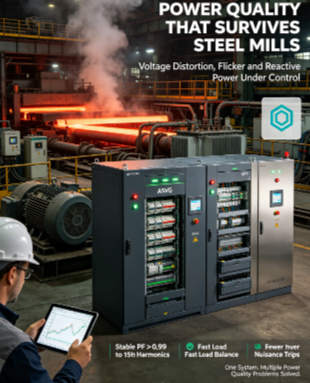
Les deux aspects des problèmes de qualité de l’énergie
Dans les environnements des aciéries, deux problèmes principaux de qualité de l’énergie nécessitent une attention immédiate :
1. Distorsion harmonique du courant (THDi)
Les charges non linéaires telles que les fours à induction moyenne fréquence, les redresseurs et les variateurs de fréquence injectent des courants harmoniques dans le système. Ces harmoniques déforment la forme d’onde du courant, entraînant une surchauffe des transformateurs et des câbles, des déclenchements intempestifs des dispositifs de protection et une réduction de la durée de vie des équipements. Des études ont montré que dans les laminoirs, la distorsion harmonique du courant peut dépasser 40 % même avec des équipements de compensation en place.
2. Puissance réactive et faible facteur de puissance
La nature inductive des moteurs, transformateurs et fours consomme une quantité importante de puissance réactive. Cela entraîne un faible facteur de puissance, ce qui signifie :
Des pertes en ligne et une charge des transformateurs plus élevées
Une augmentation des coûts d’électricité due aux pénalités des fournisseurs d’énergie
Une réduction de la capacité disponible de l’infrastructure électrique existante
Comment l’ASVG transforme la qualité de l’énergie des aciéries
Le générateur statique avancé de puissance réactive (ASVG) est un dispositif actif de correction du facteur de puissance basé sur des IGBT qui fournit une correction dynamique, progressive et déséquilibrée du facteur de puissance. Voici ce que l’ASVG apporte à votre aciérie :
Compensation dynamique de la puissance réactive — L’ASVG surveille en continu la charge et injecte ou absorbe de la puissance réactive en temps réel, maintenant le facteur de puissance proche de l’unité (supérieur à 0,99).
Atténuation des harmoniques — L’ASVG annule activement les harmoniques jusqu’au 15e ordre en injectant des contre-courants qui neutralisent la distorsion harmonique.
Équilibrage des charges — L’ASVG corrige les déséquilibres triphasés causés par des charges réparties de manière inégale, réduisant les pertes supplémentaires et la surchauffe des équipements triphasés.
Réponse en millisecondes — Grâce à la technologie IGBT avancée, l’ASVG répond aux variations de charge en quelques millisecondes, supprimant efficacement le papillotement de tension et les fluctuations.
Les avantages réels pour votre aciérie
| Avantage | Impact |
|---|---|
| Amélioration du facteur de puissance à >0,99 | Réduction des factures d’électricité, suppression des pénalités des fournisseurs d’énergie |
| Réduction de la distorsion harmonique | Durée de vie prolongée des équipements, réduction des temps d’arrêt |
| Stabilisation de la tension | Qualité de production constante, moins de produits rejetés |
| Réduction des pertes en ligne | Consommation d’énergie réduite, opérations plus écologiques |
| Équilibrage triphasé | Réduction de la surchauffe des équipements, moins de déclenchements des protections |
Questions-réponses : Pourquoi l’ASVG surpasse l’AHF dans les environnements à forte distorsion de tension
Q : Quelle est la principale limitation de l’utilisation d’un filtre actif d’harmoniques (AHF) dans les aciéries présentant une forte distorsion de tension ?
R :Les filtres actifs d’harmoniques sont principalement conçus pour atténuer lesharmoniques de courantLorsque le point de couplage commun présente déjà une forte distorsion detension(THDv), l’AHF doit d’abord « absorber » cette distorsion entrante avant de pouvoir traiter les harmoniques générées par les charges internes. Dans certains cas, jusqu’à 30 % de la capacité de l’AHF peut être utilisée pour nettoyer la distorsion de tension côté réseau. Avec un THD de tension élevé (>5 %), les AHF seuls ne peuvent pas constituer la solution idéale, car le dimensionnement requis devient excessivement élevé en raison des effets de résonance et d’amplification. De plus, lorsqu’un AHF est connecté à un système de distribution électrique, la distorsion harmonique totale du courant de charge peut en réalité augmenter en raison des changements dans le comportement de commutation du redresseur.
Q : Que se passe-t-il lorsque la distorsion de tension atteint 25 % de THDv — un AHF peut-il la gérer ?
R :À 25 % de THDv, un AHF fait face à une tâche presque impossible. Le filtre devrait être considérablement surdimensionné — potentiellement 150 % ou plus de la capacité initialement estimée — simplement pour surmonter la distorsion ambiante. Cela entraîne des coûts prohibitifs, une empreinte accrue et une contrainte thermique plus élevée sur les composants du filtre. L’algorithme de contrôle de l’AHF peut également devenir instable dans de telles conditions de tension fortement déformées, car les références harmoniques qu’il tente d’injecter deviennent elles-mêmes déformées. Dans de nombreux cas, l’AHF ne peut tout simplement pas fournir les performances d’atténuation des harmoniques attendues.
Q : Comment l’ASVG fonctionne-t-il dans des environnements présentant 25 % de distorsion de tension ?
R :L’ASVG est spécialement conçu pour résister à des niveaux élevés d’harmoniques de tension. Les solutions ASVG de pointe sont conçues pour fonctionner de manière fiable même avec un THD de tension allant jusqu’à15 %— et des configurations avancées peuvent gérer des conditions encore plus sévères. Contrairement à l’AHF, qui est un dispositif source de courant confronté à des difficultés avec la distorsion de tension, l’ASVG utilise une topologie d’onduleur multiniveau à trois niveaux et des algorithmes de contrôle sophistiqués qui restent stables en présence de forte distorsion de tension. L’ASVG ne tente pas simplement de « filtrer » les harmoniques ; il génère activement des courants de compensation qui annulent les composantes harmoniques tout en fournissant simultanément un soutien dynamique de la puissance réactive. Cette double fonctionnalité rend l’ASVG beaucoup plus résilient dans les environnements difficiles des aciéries.
Q : Quel est l’avantage global de choisir l’ASVG plutôt que l’AHF pour les applications en aciérie ?
R :L’avantage est triple.Premièrementl’ASVG fournit une correction complète de la qualité de l’énergie — compensation de la puissance réactive, atténuation des harmoniques jusqu’au 15e ordre et équilibrage des charges — le tout dans un seul appareil. L’AHF seul ne traite que les harmoniques et nécessite un équipement séparé de compensation de la puissance réactive.Deuxièmementl’ASVG est conçu pour les environnements industriels difficiles avec une forte distorsion de tension, tandis que les performances de l’AHF se dégradent considérablement lorsque le THDv dépasse 5 %.Troisièmementl’ASVG offre un meilleur retour sur investissement à long terme, car il élimine le besoin de plusieurs appareils, réduit la complexité d’ingénierie et fournit des performances plus fiables dans les conditions extrêmes typiques des aciéries.
Conclusion : Choisissez l’ASVG pour la fiabilité des aciéries
Les aciéries présentent certains des défis les plus importants en matière de qualité de l’énergie dans le monde industriel. La combinaison des fours à induction, des laminoirs, des grues, des pompes et de l’éclairage crée une combinaison idéale d’harmoniques, de problèmes de puissance réactive et de distorsion de tension. Alors que les filtres actifs d’harmoniques peuvent fonctionner dans des environnements plus propres, ils atteignent leurs limites lorsque la distorsion de tension dépasse 5 % — une situation courante dans les aciéries.
L’ASVG est la solution éprouvée. Conçu pour résister à une forte distorsion de tension, fournir une compensation dynamique de la puissance réactive, atténuer les harmoniques et équilibrer les charges — le tout dans un ensemble compact et robuste — l’ASVG garantit que votre aciérie fonctionne de manière fiable, efficace et rentable.
Prêt à transformer la qualité de l’énergie de votre aciérie ? Contactez notre équipe sales@yt-electric.com aujourd’hui pour discuter de la manière dont l’ASVG peut être adapté à votre application spécifique.



 réseau ipv6 pris en charge