

 français
 English
 Deutsch
 español
 العربية
 中文

An automotive plant does not have one harmonic problem. It has three, and a filter sized for one will not fix the other two: welding transients in the body shop, steady low-order distortion from press and conveyor drives, and continuous content from paint shop rectifiers. Here is what each costs, and how to size a filter from a real survey.
Resistance welding is a pulsed load controlled by thyristors. Each weld draws a large current for a few cycles and releases it, producing wideband transients and interharmonics rather than a steady spectrum. Six-pulse drives on press lines and conveyors are the opposite: predictable 5th and 7th harmonic current, typically 30% to 40% THD at full load. Paint shop rectifiers run continuously and contribute low-order distortion the whole time the line is up.
| Load group | Harmonic signature | Where it hurts |
|---|---|---|
| Resistance welding | Wideband transient, interharmonics | Voltage dips, weld scatter, robot trips |
| Press and conveyor VFDs | 5th, 7th, 11th, 13th | Transformer heating, PF penalty |
| Paint rectifiers, lighting, chargers | Low order and 3rd harmonic | Distortion at PCC, neutral overload |
The welding line is the hard part for a specific reason. Thyristor welders fire at an angle measured from the voltage zero crossing, so a distorted supply moves the zero crossing and the firing angle with it. Weld current then deviates from the schedule even though nothing in the controller changed, and the symptom shows up as nugget scatter and spatter rather than as an obvious electrical fault. A filter only helps if its response is fast enough to act inside the weld cycle: under 5 ms, not after it.
Take a 690 V board at 1,400 kVA, line current 1,171 A, with 28% current THD. About 328 A of that is harmonic current doing no useful work. Filtering to a 5% residual leaves roughly 59 A.
The headline is not the 82% current reduction. It is what happens to losses: harmonic eddy losses rise approximately with the square of harmonic current, so they fall by about 97%. That converts directly into hot-spot temperature, insulation life, and the derating headroom a plant needs under IEEE C57.110 to defer a transformer upgrade. Total line current, by contrast, falls only a few percent, because the fundamental is untouched. A proposal claiming the filter releases half the transformer capacity is not credible to a plant engineer; one that shows the loss reduction usually is.
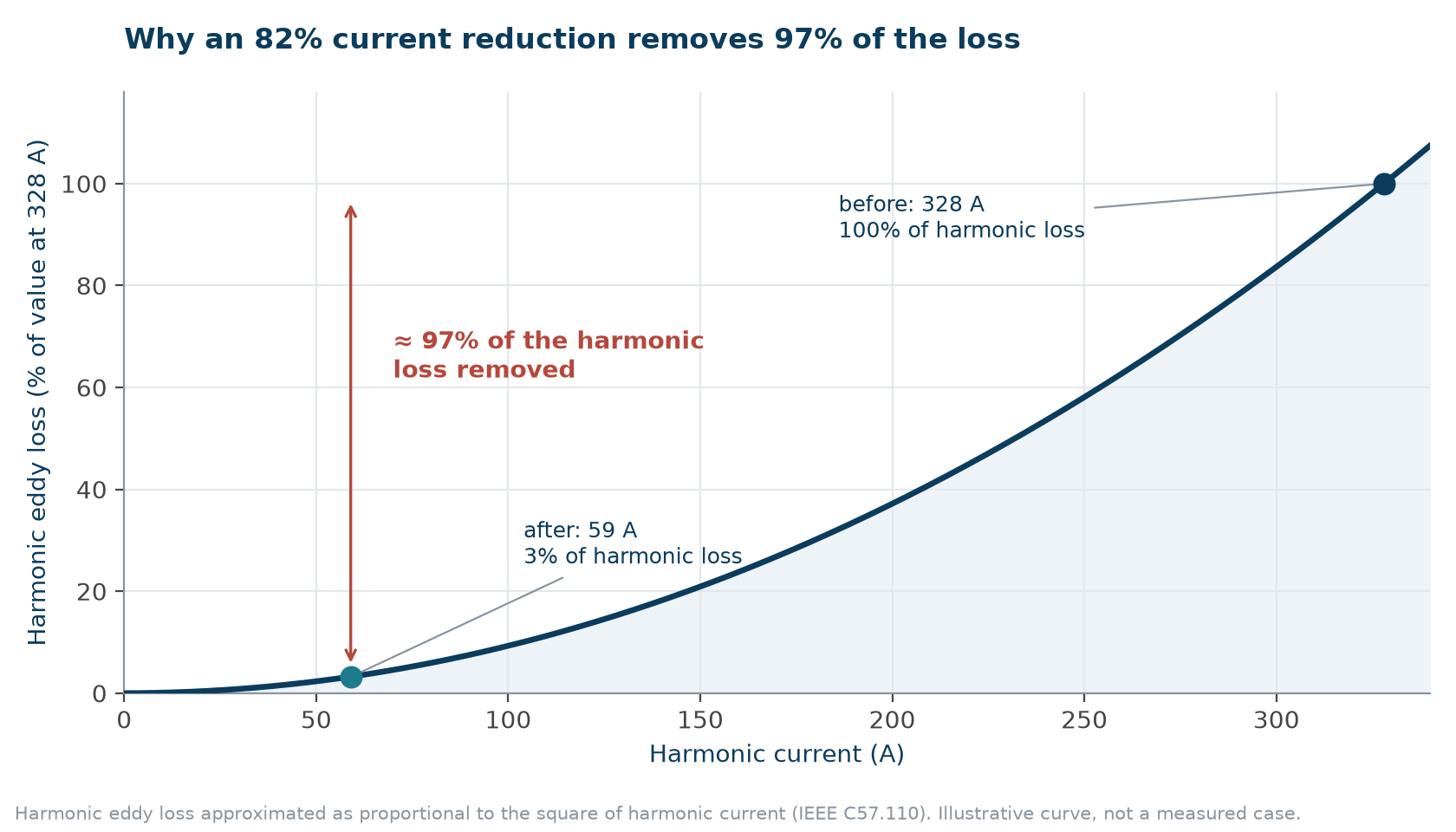
Figure 1 - Harmonic eddy loss falls with the square of harmonic current: an 82% current reduction removes about 97% of the loss
| Step | Calculation | Result |
|---|---|---|
| Line current at 1,400 kVA, 690 V | 1,400,000 / (1.732 x 690) | 1,171 A |
| Harmonic current at 28% | 1,171 x 0.28 | 328 A |
| Permitted at a 5% target | 1,171 x 0.05 | 59 A |
| Harmonic current to absorb | 328 - 59 | 269 A |
| Filter rating | Next standard size above 269 A | 300 A |
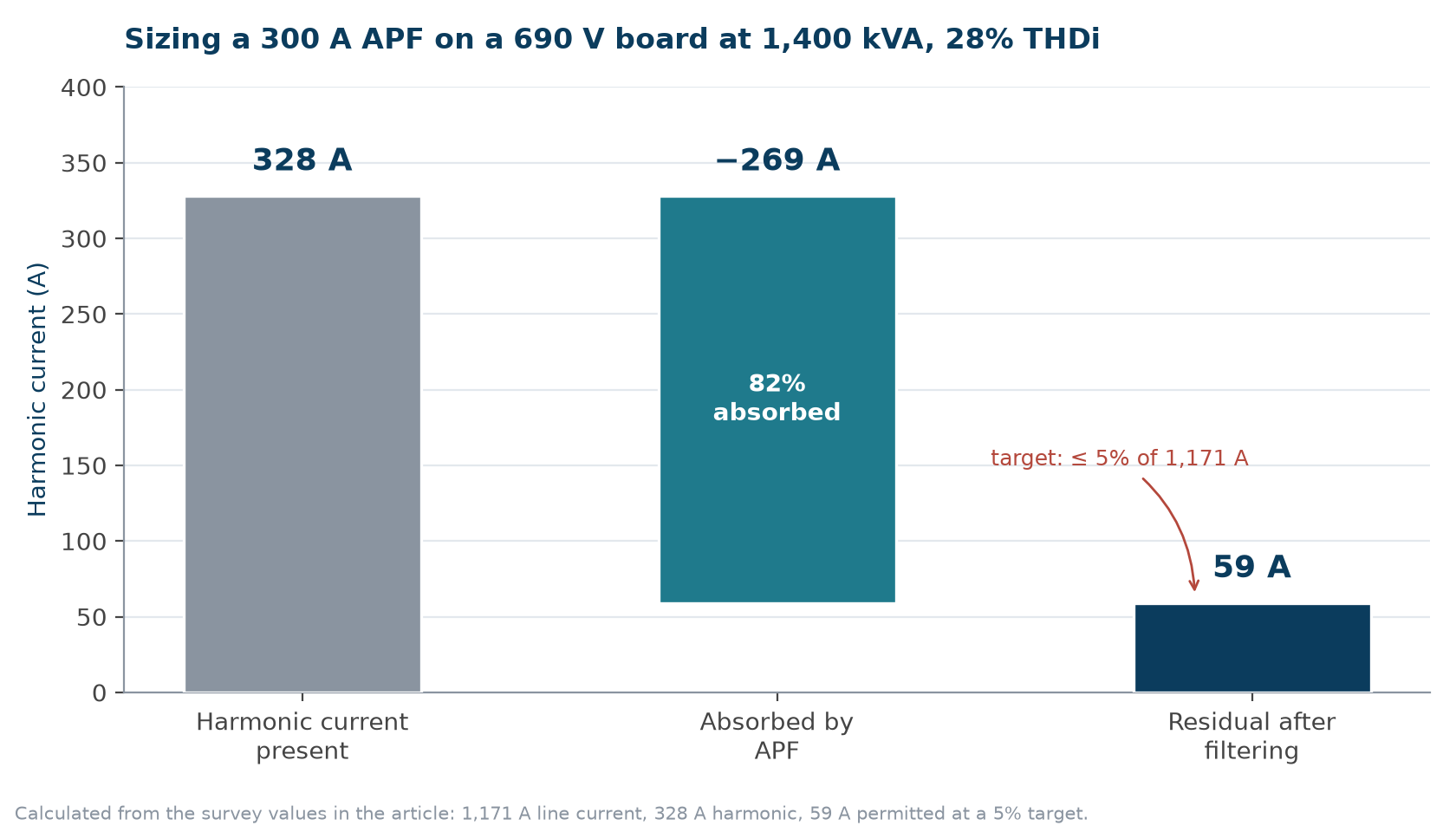
Two things decide whether that rating survives commissioning. The survey must be taken with the welding line running, over a full production week, reported at the 95th percentile; a snapshot from a maintenance window undersizes the filter permanently. And the module is selected on its current at the actual switch room temperature, not on the nameplate rating at 35 C.
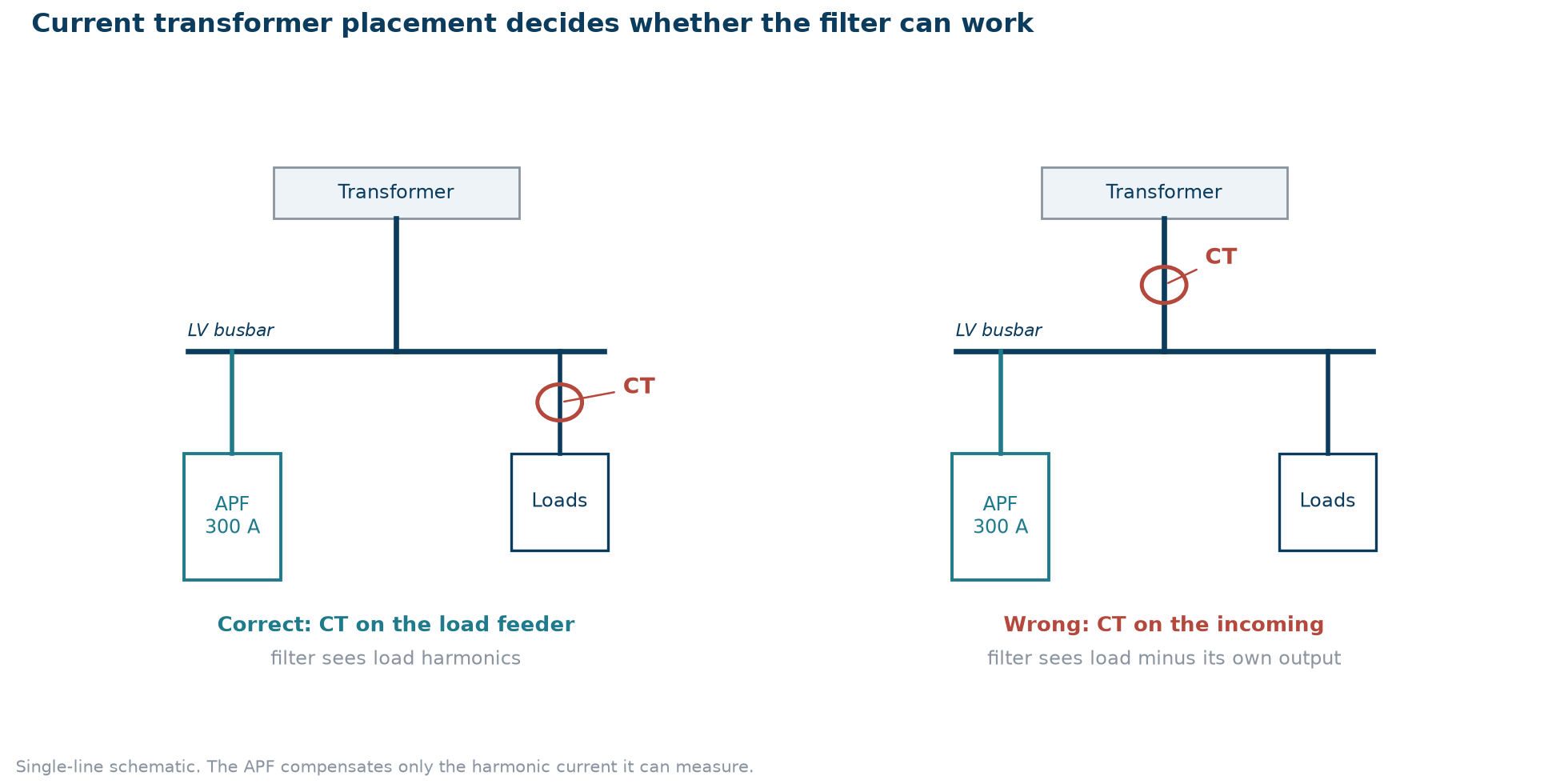
Placement follows one rule: current transformers on the load side of the filter connection, so the filter measures the harmonic-producing load rather than the sum of load and its own output. If the bus can be reconfigured during normal operation, distribute the compensation across boards. If the load paths are fixed, centralise it.
Do MFDC welders still need a filter? Less urgently than thyristor units, because the inverter stage is insensitive to zero-crossing error. They still contribute harmonic current through their rectifiers, and the rest of the plant usually justifies the filter on its own.
Will it reduce the electricity bill? Only slightly: the direct saving is the harmonic loss component. The larger effects are avoided line stops, deferred transformer capacity and reduced weld scrap.



 réseau ipv6 pris en charge